Everyone knows about body posture. The face has a resting shape too, and I call it facial resting posture. It decides what expression you seem to wear when you are not smiling or speaking.
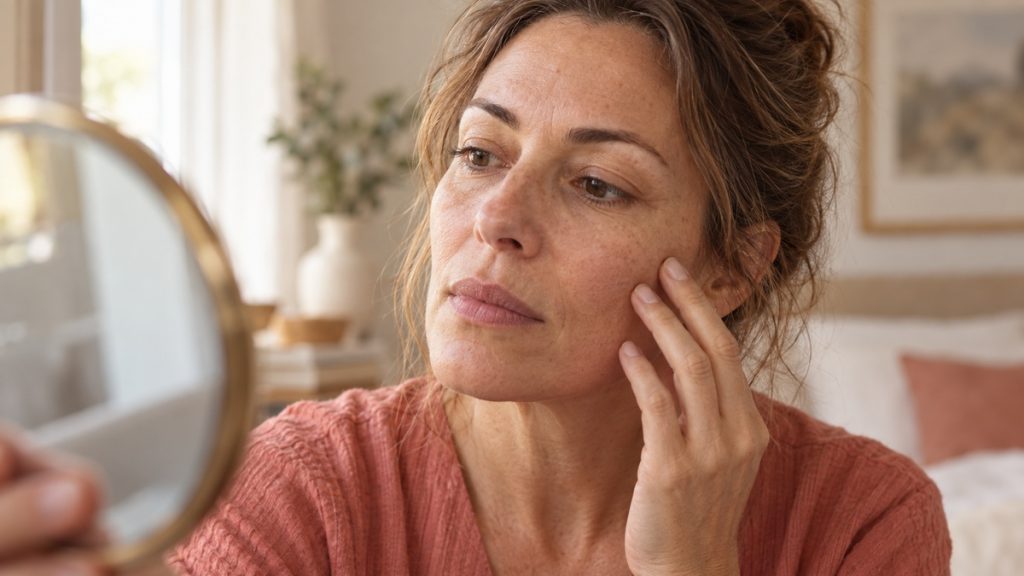
Some people look angry the moment they relax.
They are not angry. They are simply making no expression.
Two lines between the brows stay faintly drawn in, and the corners of the mouth stay faintly turned down. They have no idea. The person in the mirror does.
That look, the look of a face making no expression, is what I call facial resting posture.
Facial Resting Posture(臉態)
When the face makes no expression: the length each muscle stops at, the tension it holds, and the overall shape held up by the fat, ligaments and bone beneath.
Established knowledge — what the field already knows: anatomy, physiology, mechanism, established risk. The next study does not rewrite it.
Published evidence — research done on this specific question, with its size and limits stated. The finding may be positive or null, and later work may revise it.
Clinical consensus — practice that physicians in this field broadly agree on.
Clinical observation — what I have seen in my own clinic, with the scope of it stated.
Working hypothesis — my own reasoning, which I cannot yet support. I expect to be wrong about some of it.
- Starting from body posture
- What I look at: tension at rest
- Resting length is shaped by use
- Two directions with age
- Why I look at resting posture first
- One thing you can do today
- Common questions
Starting from body posture
Everyone understands body posture.
When someone stands still, you can see whether they stoop, whether one shoulder sits higher, whether the pelvis tips forward.
None of that depends on what they are doing right now. It builds up day by day from how they sit, stand and use their body.
The face works the same way.
| Body posture | Facial resting posture | |
|---|---|---|
| When to look | Standing still | Making no expression |
| What you see | How the frame lines up: stoop, uneven shoulders, tilted pelvis | How long the muscles stop, and how much tension they hold |
| Where it comes from | How you sit and stand each day | How you use your face each day |
When your face stops, every expression muscle stops at some length, holding some amount of tension.
Some stop too short and stay faintly drawn in. Some stop too slack and cannot hold up what sits above them.
Put together, that is your facial resting posture.
What I look at: tension at rest
When I look at resting posture, I look at the muscles as they rest. Expressions can wait.
The reason is simple. An expression lasts a moment. Resting posture lasts all day.
If a muscle stays faintly drawn in all day, its pull on the skin never stops. That matters far more than how many times you frown. Working hypothesis
A lot of compensation hides in this resting tension too. One muscle underworks, so the one beside it keeps helping. After long enough, the helper stops at a short length and does not come back. Clinical observation
Resting length is shaped by use
Take frowning.
Someone who habitually frowns has a corrugator muscle working all day in a shortened position.
Sports medicine has a fairly consistent finding. Muscle working in a lengthened position tends to grow more and grow better. Muscle working only in a shortened position does worst. Published evidence
What the research says: a review of 26 studies found that isometric training at long muscle lengths produced more growth than at short lengths. A 2025 meta-analysis also pointed to heavy loading at long lengths as the key to muscle lengthening. All of this comes from the limbs. Applying it to the face is my own inference. Working hypothesis
Back to the corrugator. Working all day at short length, it is training itself in the least rewarding way. It gets shorter and stiffer, and its resting length settles at the short end.
That is why people tell me: “I know I am frowning, but I cannot let it go.”
They are telling the truth. The resting length of that muscle has been used short.
Two directions with age
A muscle that rests well can do two things:
- Lengthen: it can be drawn out when it should relax
- Contract: it can pull in when it should work
With age, the range narrows at both ends.
Some people show the “cannot lengthen” side. A French plastic surgeon compared expression muscles across ages with MRI. In younger people the muscles were curved, with fat cushioning beneath them. In older people, some had straightened and shortened, with higher resting tension, pressing the fat beneath out of place. Published evidence
What the research says: this is the author’s own theory, and the images compare different people at different ages. The same people were not followed over time.
Others show the “cannot contract” side: the muscle lacks strength and cannot hold things up.
Both are right, about different muscles.
A Hong Kong study followed 172 people aged 60 to 80 for a year and a half. Thigh muscle stiffened by about 9% a year while strength fell by about 8% a year. Stiff and weak can happen together. Published evidence
What the research says: this is leg data. Whether expression muscles stiffen or soften with age has not been followed in the same way.
So a resting posture that has gone off rarely looks just one way. On the same face, a few muscles are often too tight while a few are too slack. Clinical observation
Why I look at resting posture first
Many people open with: “I want to do something about my nasolabial fold.”
I ask them to relax first, make no expression at all, and let me look.
That fold is a result. What I want to know is which muscles have stopped where, pulling it and folding it into place.
The ones too tight, I want to relax. I call that resetting. The ones too slack, I want to wake. I call that waking.
| Stopped too short | Stopped too slack | |
|---|---|---|
| How it rests | Faintly drawn in, cannot let go | Cannot hold up what sits above it |
| What to do | Reset: let it relax | Wake: get it working |
The same face often needs both. Strengthening everything or relaxing everything will do the wrong thing on one side.
Facial acupuncture adjusts the elasticity and tension of these muscles. In the tent model they are the guy lines, the only part of the tent that moves on its own.
One thing you can do today
Find a mirror with even light.
Make a few big expressions first: frown, grin, purse your lips. Then let go completely, close your eyes and count to thirty.
Open your eyes, adjust nothing, and take a photo.
That photo is your facial resting posture as it stands today.
Look at three places:
- Between the brows: is anything faintly drawn in?
- The corners of the mouth: level, up or down?
- The chin: a little puckered, as if working?
Wherever you see drawn in, down or puckered, a muscle is still working while it should be resting.
Seeing it is enough for now. Many people find out from this first photo that when they relax, their face has not.
Rest is shaped by movement too
Resting posture only counts the moments when the face stops.
A face spends much of the day talking, laughing and making expressions, though. Whether the right muscles move, whether unrelated ones join in, and whether everything comes back afterwards all slowly rewrite how the face rests.
I call that moving side facial expression recovery(臉韻). It has its own article in Chinese, and its definition is in the glossary (in Chinese).
Common questions
What is facial resting posture?
It is the length each muscle stops at when the face makes no expression, the tension it holds, and the overall shape held up by the fat, ligaments and bone beneath. Like body posture, it describes how things rest, and it builds up from how you use your face each day.
How is it different from an expression?
Resting posture only counts the moments when the face stops. An expression lasts a moment; resting posture lasts all day. If a muscle is still working faintly at rest, its pull on the skin has not stopped.
My relaxed face looks stern or tired. Is that resting posture?
Very often. Brows faintly drawn in and mouth corners turned down at rest mean some muscles are working when you are making no expression. The first step is to see which are too tight and which too slack, then decide whether to relax them or wake them.
Can it change?
It is shaped by use, so it has room to change. Facial acupuncture can adjust the elasticity and tension of the muscles. Everyday habits and practice decide whether that adjusted state holds.