Radiofrequency, focused ultrasound, threads, lasers, microneedling, skin boosters, peels, skincare, facial acupuncture: each moves a different part of the face, and each costs something different if it disappoints. Which one you should have, I cannot tell you through a screen. What I can do is show you how to judge it.
Anyone who wants to look after their face gets stuck on the same question: there are so many treatments, so which one?
My own order runs the other way. I look first at which part is ageing, and choose the tool last.
If the part has not been identified, even a good tool can land in the wrong place. And a clinic will usually tell you the effect, how long it lasts, and how many sessions make a course. Two things come up less often: these treatments do not reach the same layer, and if the result disappoints, the difficulty of putting it right varies enormously.
Established knowledge — what the field already knows: anatomy, physiology, mechanism, established risk. The next study does not rewrite it.
Published evidence — research done on this specific question, with its size and limits stated. The finding may be positive or null, and later work may revise it.
Clinical consensus — practice that physicians in this field broadly agree on.
Clinical observation — what I have seen in my own clinic, with the scope of it stated.
Working hypothesis — my own reasoning, which I cannot yet support. I expect to be wrong about some of it.
- Fourteen tools, one table: which part each one moves
- Slack skin, folds, pigment, scars: where to start
- The first question: cause or result?
- These treatments do not reach the same layer
- Five parts, and how I look after each
- The fabric has the most tools
- Facial acupuncture and the microblade needle
- Order and rhythm
- Each treatment in detail
- What happens when each one disappoints
- Six questions to have ready before you walk in
- Keep a record card for your own face
- Repair the supply first
- Common questions
Fourteen tools, one table: which part each one moves
I explain facial ageing with a tent. Bone is the foundation, fat pads are the air inside, muscles and ligaments are the guy lines, fibrous tethers and scar tissue are the tie-downs, and skin is the fabric. Each part ages on its own schedule, and each tool works on only some of them.
| Tool | Part it moves | In one line |
|---|---|---|
| Facial acupuncture | Guy lines | Adjusts the elasticity and tension of the line: loosens what is tight, wakes what is slack |
| Facial exercises | How the guy lines are used | Learning how to pull the line |
| Gua sha, manual release | Guy lines | Works a taut line loose |
| Botulinum toxin | Guy lines | Gives one line temporary leave |
| Thread lifting | Beside the guy lines | Hangs an extra line to carry the fabric up |
| Microblade needle | Tie-downs, locked guy lines | Cuts what has been tied in the wrong place |
| Radiofrequency | Fabric | Like tumble-drying a jumper: heat shrinks the fibres |
| Focused ultrasound | Fabric, can reach fascia | Like a magnifying glass: heat gathered at one deep point |
| Picosecond laser | Fabric | Shatters a stain, and the body carries it away |
| Microneedling | Fabric | Pricks tiny holes so the fabric mends itself |
| Skin boosters | Fabric | Puts water into the fabric: small amounts, placed shallow |
| Chemical peels | Outer layer of the fabric | Brushes off the outermost coat of old paint |
| Skincare | Daily care of the fabric | Sunscreen is an umbrella; the rest is upkeep |
| Fillers | Air | Like pumping up a balloon: replaces lost volume |
The air here belongs to the balloon image only. It has nothing to do with qi in Chinese medicine.
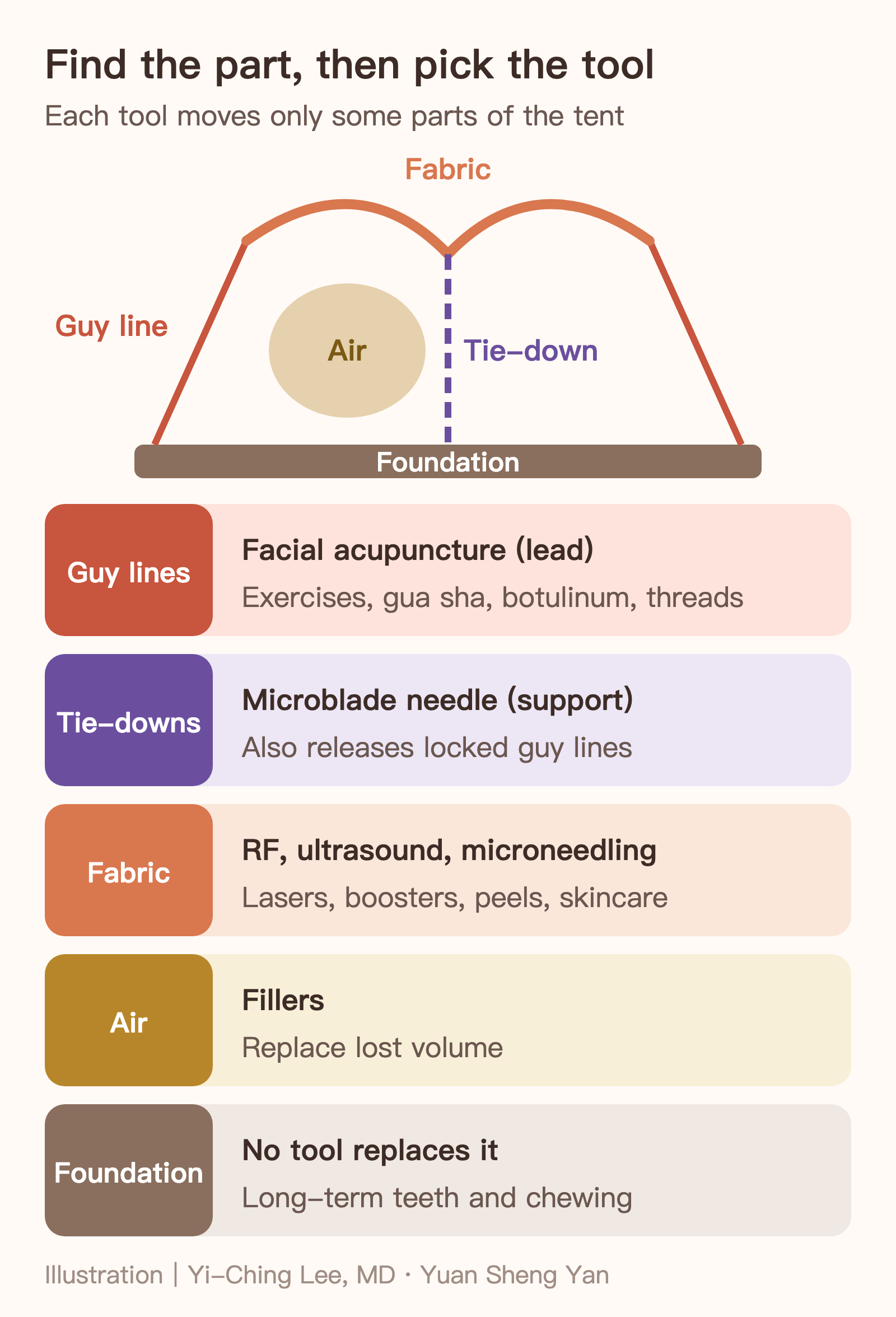
Of these I perform facial acupuncture, microneedling and the microblade needle. Whether anything else suits you is for the physician performing it to assess.
Slack skin, folds, pigment, scars: where to start
The same complaint can come from a different part in different people. This table is a starting point for thinking. Whether something suits you depends on someone actually looking at your face.
| What bothers you | The part I look at first | Tools to start thinking about |
|---|---|---|
| Frown lines, forehead lines, crow’s feet | Guy lines: which muscle keeps working | Facial acupuncture, botulinum toxin |
| Nasolabial folds, marionette lines | Whether it is held, tethered or descended | Facial acupuncture, microblade needle; if volume has gone, fillers |
| Lower-face slackness, a blurred jawline | Guy lines or fabric, and which accounts for more | Facial acupuncture, focused ultrasound, radiofrequency, threads |
| Mouth corners at uneven heights | How the guy lines are used | Facial acupuncture, facial exercises |
| Pigment, dullness | Fabric | Picosecond laser, chemical peels, sunscreen |
| Acne scars | Fabric; for depressed scars, tie-downs too | Microneedling, microblade needle |
| Hollows, a tired look | Air | Fillers |
The first question: cause or result?
When I see a line or a hollow, I do not go straight to what to use. I ask whether what I am looking at is a cause or a result.
- If it is a result, I go upstream and look for the muscle pulling it into that shape
- If it is a cause, I work there
- If it has nothing to do with muscle, because volume has gone or bone has changed, needles cannot reach it, and I say so before anything else
The place people mind is often just the last place the problem shows. The muscle doing the work may be somewhere else.
These treatments do not reach the same layer
A face is not a sheet of skin. From outside in it has at least six layers: epidermis, dermis, fat pads, fascia, muscle, bone. In ageing all six change together — skin thins, dermal collagen falls, fat pads shift and shrink, fascia slackens, muscle tone changes, and bone is quietly resorbed.
Which is why “does this treatment work?” has no available answer. The question is: which layer does it work on?
| Treatment | The layer it mainly reaches | What it does there |
|---|---|---|
| Lasers, picosecond lasers | Epidermis to superficial dermis | Light energy breaks up a specific target, or stimulates rebuilding |
| Microneedling | Epidermis to dermis | Creates controlled micro-injuries, trading them for a repair response |
| Skin boosters (micro-injections of hyaluronic acid) | Superficial dermis | Small amounts of hyaluronic acid and nutrients placed in the skin, for hydration |
| Radiofrequency | Dermis to subcutis | Heat contracts collagen, then stimulates new collagen |
| Focused ultrasound | Can reach the fascial layer | Heats discrete deeper points, producing deep contraction |
| Fillers | Subcutis to deep volume | Replaces what has hollowed, directly |
| Thread lifting | Subcutis to fascia | Threads carry tissue upward, plus fibrosis from the foreign-body response |
| Botulinum toxin | Muscle | Reduces the contraction of specific muscles, so a line loses one of its chances to be folded in |
| Facial acupuncture | The tone of muscle and fascia | Fine-needle stimulus, with the body doing the readjusting |
| Microblade needle | Adhesions, fibrous tethers, locked muscle | A flat needle edge cuts them and releases tension |
This table does not tell you which is best. It tells you that if what has slackened is fascia, no amount of laser will move your face off the position it is hanging in — and if your complaint is skin texture, no depth of lifting will refine the skin.
So ask yourself one question first: what you dislike in the mirror — is it the quality of the skin, the position of the face, or the fact that the face has emptied? Those three answers lead to three completely different layers.
Why the layer is the first question
What I meet most often in clinic is someone who has had a good deal done, spent a good deal, and still looks in the mirror feeling something is off. Clinical observation
Asking further usually turns up the same thing: the layer treated and the layer she minds about were not the same layer.
Someone whose cheeks have emptied goes for lifting; the skin is tighter, the hollow is still hollow, and the extra tightness can make it read emptier. Someone whose complaint is rough texture has filler; the face is fuller, the texture has not changed at all. The treatment did not fail. It did its work, on a layer she was not concerned about. She bought the wrong layer.
Five parts, and how I look after each
Guy lines: facial acupuncture leads, practice takes over
Bone decides where the tent stands. The guy lines decide how far the fabric opens. So I usually begin here: facial acupuncture works on muscle and fascia, loosening what is tight and waking what is slack. Once elasticity and tension are right, how it is used is up to you. Gua sha and manual release also work on this layer, in loosening the lines.
Published evidence In one randomised trial of 34 women, five times a week for eight weeks, muscle tone and stiffness fell in the gua sha group and skin elasticity rose in the roller group. The two groups were compared with each other, with no untreated control.
Botulinum toxin works on this layer as well, by making a chosen muscle work less for a while, so it does best with lines folded in by expression. A thread hangs an extra line beside the guy line and carries the fabric up; the body’s response around the thread adds to the sense of support.
Published evidence A meta-analysis of upper-face botulinum toxin covered 14 randomised trials and 8,369 people: the effect is clear and fades at about six months. A meta-analysis of thread lifting covered 26 studies: satisfaction fell from 98% just after treatment to 88% at six months, and the commonest problems were swelling (35%) and skin dimpling (10%). A separate systematic review judged the lifting effect to be limited in duration.
Tie-downs: the microblade needle cuts
Tie-downs are the fibrous tethers and scars that bind skin downward. Where one is tied in the wrong place, the fabric is pulled into a groove. No adjustment of the muscle will release that. It has to be cut.
Some muscles are so locked that facial acupuncture cannot shift them, and there I also use the microblade needle to release the tension directly. The muscle takes a small injury in the process and regrows. In my practice the microblade needle is always a support; facial acupuncture leads.
Working hypothesis “Release plus regeneration” is reasoned from elsewhere in the body. Mouse muscle repeatedly dry-needled had nearly regenerated within seven days, and human trapezius softened on ultrasound after needle-knife treatment, in a small study with no control group. There is no such research on the muscles of facial expression.
Fabric: treating the skin itself
When the skin itself has aged, the work is in the dermis and epidermis. This layer has the most tools, and I take them apart in the next section.
Air: lost volume cannot be trained back
When fat pads shrink, that is a question of volume. No amount of exercise or needling produces the original bulk, so this has to be replaced. What is placed also stretches the fabric, and research has seen the skin’s repair cells start work as a result.
Published evidence That finding comes from forearm skin and injected filler. Whether every site on the face behaves the same way cannot be assumed.
Foundation: no tool replaces it
None of these tools replaces bone. Lose teeth or stop chewing, and alveolar bone is resorbed, so the foundation depends on long-term care of the teeth and chewing. This is also something I say plainly at the start.
The fabric has the most tools
These tools manage the fabric. Where the face hangs is mostly outside their remit.
| Tool | What it mainly addresses | Know first |
|---|---|---|
| Radiofrequency | Skin that is not firm enough | Works by heat; mention it if your face is already thin |
| Focused ultrasound | Mild to moderate laxity of the lower face and neck | Results fall off with greater laxity |
| Picosecond laser | Spots, pigment, some skin texture | Usually several sessions; can darken temporarily |
| Microneedling | Acne scars, texture | Needs a physician’s assessment; do not roll at home |
| Skin boosters | Hydration, skin quality | Replaces water; facial contour is not its department |
| Chemical peels | Roughness, dullness | Irritating; be stricter with sunscreen afterwards |
| Skincare | Daily protection | Cannot reach muscle or replace volume |
Published evidence A review of focused ultrasound (16 studies) found it effective in women with mild to moderate laxity, with brow elevation of about 0.5 to 1.7 mm; US adverse-event reports include cases of fat atrophy and nerve symptoms, though such reports cannot give a rate. A review of radiofrequency (15 studies, 1,230 people) found most people improved in texture and firmness, with methodological limits.
Published evidence A review of picosecond lasers (77 studies) found the strongest evidence for tattoo removal, with support for pigment and rejuvenation. In one deep pigment condition about one in five had temporary darkening. A meta-analysis of microneedling (21 studies, 723 people) reported 83% satisfaction, with no standard way of grading appearance. A meta-analysis comparing lasers and chemical peels (38 studies, 1,695 people) found similar overall effects on photoageing; lasers took fewer sessions and hurt more in the short term.
Within skincare, sunscreen has the strongest evidence. An Australian trial followed 903 people for four and a half years: those using sunscreen daily showed 24% less skin ageing than those using it at their own discretion.
Retinoids also have research behind them for fine lines, with more irritation. Prescription retinoids are medicines, so ask a physician first if you are pregnant or planning to be.
Published evidence A meta-analysis of tretinoin covered 8 randomised trials and 1,361 people, with improvement in fine and coarse wrinkles. In a systematic review of skincare ingredients, retinol and vitamin C had the highest grade of recommendation, and many ingredients remain uncertain.
Facial acupuncture and the microblade needle
These two are easy to confuse. The instruments differ, and so do the places they work.
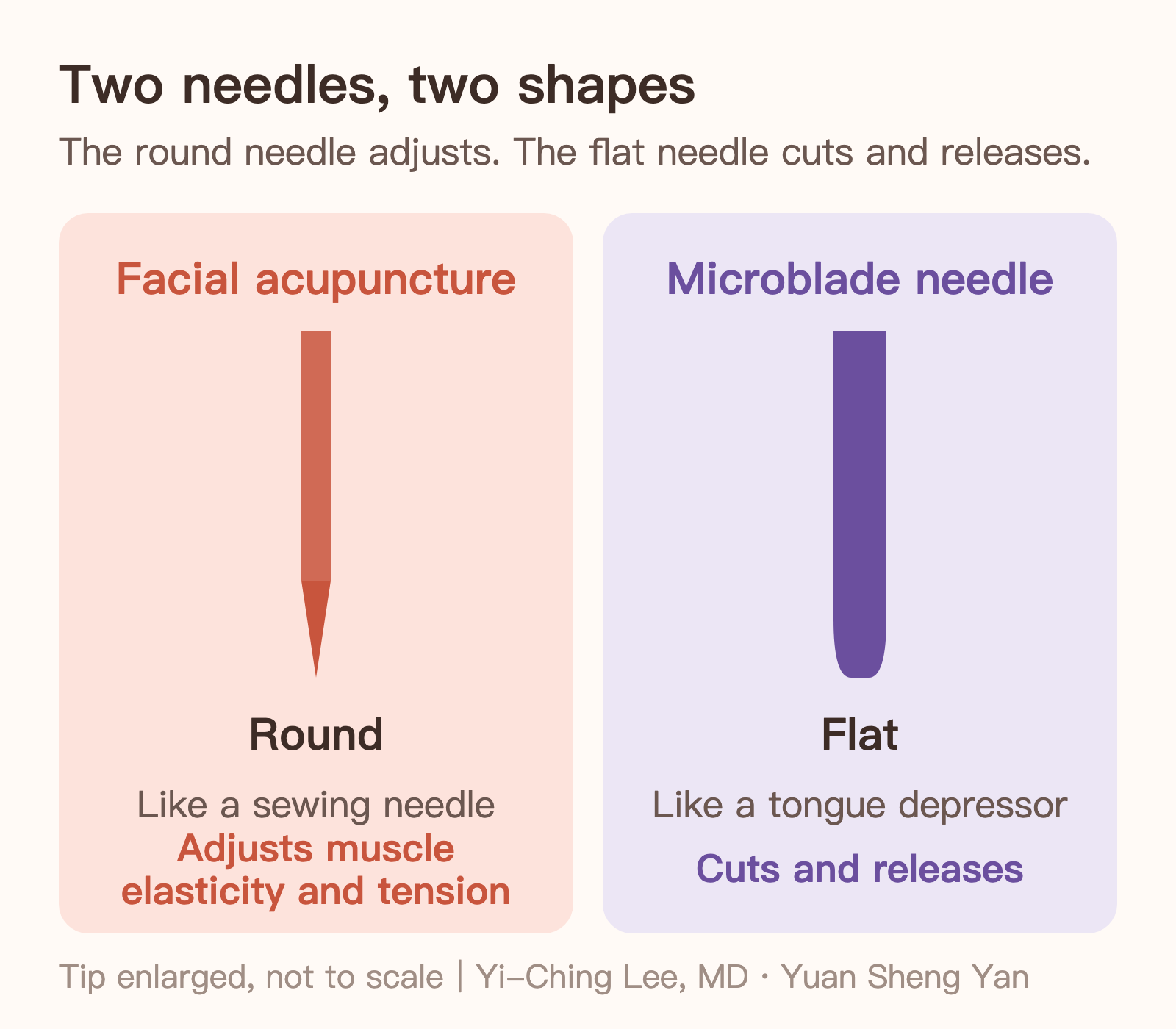
The simplest difference is the shape of the needle. A facial acupuncture needle is round, like a sewing needle. A microblade needle is flat, like a tongue depressor. Being flat is what lets it cut and release. The tip curves inward with rounded corners, which limits unnecessary damage to the tissue. The round needle adjusts. The flat needle cuts and releases.
| Facial acupuncture | Microblade needle | |
|---|---|---|
| Shape of the needle | Round, like a sewing needle | Flat, like a tongue depressor, with a tip that curves inward and rounded corners |
| Part it moves | Guy lines: muscle and fascia | Tie-downs, plus locked guy lines |
| What it does | Adjusts elasticity and tension: loosens what is tight, wakes what is slack | Cuts and releases adhesions, and releases severe tension |
| When it is used | The starting point for most muscle problems | Adhesions, scars, or where facial acupuncture cannot shift things |
| Role in my practice | Lead | Support |
Order and rhythm
Even with the right tools, order changes the result. I adjust the tight muscle first and cut the tie-down afterwards. Done the other way round, the place just cut gets pulled back by the muscle that is still tight.
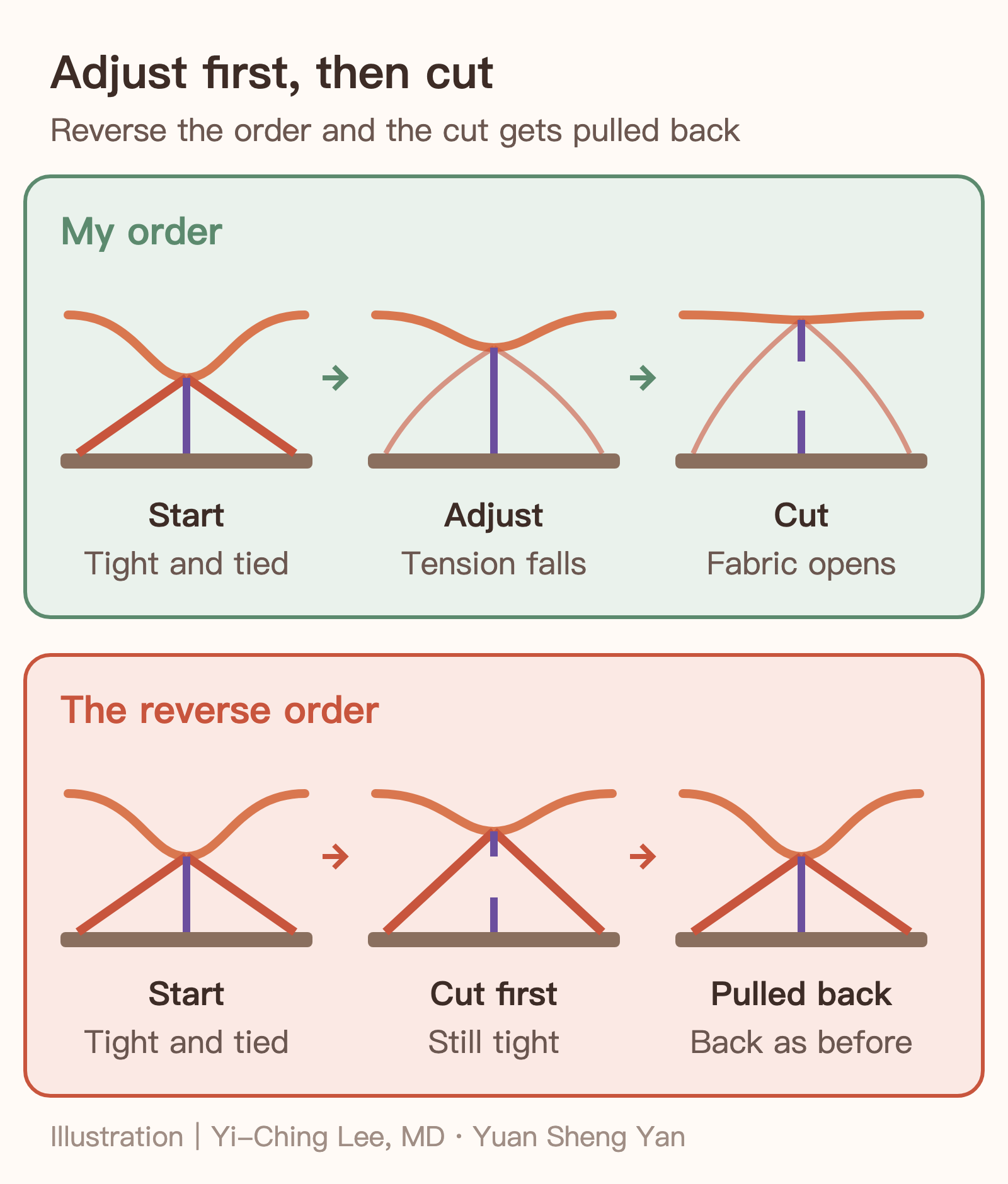
Working hypothesis This order comes from clinical reasoning. No study has compared the two sequences directly.
The right tool also needs enough time. I divide facial acupuncture into two phases.
| Intensive phase | Maintenance phase | |
|---|---|---|
| Interval | Every 1 to 2 weeks | 3 weeks or more |
| Duration | 6 to 10 consecutive weeks | Every 4 to 8 weeks, according to the muscles |
| For whom | People starting out | People who have completed an intensive phase |
A single session holds for three weeks at most. Someone with little muscle does not grow definition from one workout. It takes concentrated training first; after that, spacing it out maintains what was built. The face works the same way.
Each treatment in detail
The sections below go through the treatments by depth: what each does, what I see in clinic, and where the limits lie.
Epidermis to dermis: lasers, picosecond lasers, microneedling, skin boosters
This layer deals with the quality of the skin itself: colour, texture, fine lines, pores, scars, hydration.
Lasers and picosecond lasers
The principle is selective delivery of energy to a specific target — pigment, vessels, water — so that it is destroyed or stimulated into rebuilding. Clinical consensus This belongs to the Western medical side and I do not perform it, but you should know its boundary: it can make skin look better, and where the face hangs is not its department.
Microneedling
What microneedling is, underneath, is the creation of controlled micro-injuries, traded for a repair response. Clinical consensus It makes skin regrow. It does not make skin thinner — that is the common misunderstanding.
I do perform microneedling myself (the same needle at different depths is doing different things), so I can be specific here. Clinical observation It needs a physician’s assessment first, and is not done during acute inflammation or where there is a wound or infection on the face or scalp. Do not buy a home roller and roll it yourself. Infection is a problem that actually happens, and depth cannot be controlled with those.
Skin boosters
Small amounts of hyaluronic acid and nutrients injected with a fine needle into the superficial dermis, working on hydration and skin quality. Clinical consensus
They use the same family of material as fillers for an entirely different purpose: fillers replace volume, boosters replace water. Small quantity, superficial placement, and mostly reabsorbed.
What to keep in mind is that this is still an injection: too superficial or unevenly distributed and small nodules can be left, and in thin skin the colour can show through. It replaces water. The contour of your face is still not its department.
Tightness: how radiofrequency and focused ultrasound differ
These two get discussed together, and even their names in some markets sound alike — but their depths differ.
Radiofrequency uses electromagnetic energy to heat the dermis and subcutis, contracting collagen and then stimulating new collagen. Focused ultrasound concentrates ultrasound energy to heat discrete points, reaching deeper, as far as the fascial layer.
What they share matters more than what separates them: both trade heat for contraction.
Heat has a price. The temperature that makes collagen contract also acts on the fat beside it. The machine is not faulty. That temperature is how it works.
What I see in clinic
Clinical observation People who are thin, people whose faces had little volume to begin with, come out thinner. This is common enough that I now ask the question unprompted: “have you had radiofrequency or ultrasound recently?”
There is another reaction: tightness — not the tightness of looking younger, but a stiff, slightly stuck tightness. It feels different from the face that was there before.
Both of these are documented, with one boundary that matters. In the systematic review of subsurface radiofrequency, the way heat tightens skin is described plainly as coagulating the subcutaneous fat beneath it, and the most frequently recorded sequelae are hardness and palpable nodules. Published evidence That evidence concerns subsurface radiofrequency devices and should not be generalised to every surface platform. The same applies on the ultrasound side: one of its actions is reducing the size of fat cells. That is the principle behind using it for body fat reduction. Established knowledge
So “my face got smaller” is a selling point on a body and a problem on a face that had nothing to spare. The same mechanism, in a different place, means the opposite thing.
If you are already on the thin side and your cheeks are a little hollow, say so before any heat-based treatment, so the physician can decide whether to adjust the energy or avoid certain zones.
Fat that is lost does not grow back. That is the thing to know about this layer. Replacing it means filler or fat transfer — another procedure to make up for the last one. Clinical consensus
Burns
Clinical observation I have seen patients who were burned. Cases are findable online too. Energy that is too superficial or too strong can burn, and the operator’s experience and the generation of the machine both matter. Clinical consensus
As for the folk version that circulates — “too much and the flesh cooks” — Working hypothesis honestly, that is my own phrasing mixed with some internet lore. It helps people picture it, and I do not present it as an established mechanism. What is established is that burns happen, and that heat acts on fat.
And one more thing you will not hear in a clinic: a large share of the research on these devices comes from authors with a commercial interest. In the systematic review of subsurface radiofrequency, 77% of the included studies had authors with a known conflict of interest, and the author wrote the sentence “marketing precedes the science” himself. Published evidence I include it because many of the figures you hear in a consultation originate there.
In fairness: that is a pointedly argued review, and it concerns subsurface radiofrequency, which is not quite the same thing as surface devices. I use it because it sets out the mechanism most clearly.
Volume: what fillers actually replace
Filler is the most direct of these. What has hollowed is filled, and you can see it the same day. The problem it addresses is the most clearly defined: not enough volume.
Being direct is also why its problems are the most concrete.
What I see in clinic
Clinical observation Nodules and lumps are common. The most characteristic site is under the eye, where it reads as a ridge lying horizontally beneath the eye. Some people also get the Tyndall effect — a bluish cast showing through from beneath, most visible where the skin is thin.
Over longer periods there is something else: the whole face gradually puffs and flattens. The contours blunt, the features spread apart, the dimensionality fills in — what is often called a pillow face. This is usually not from one occasion. It accumulates from repeated top-ups, a little each time.
Reversibility is decided by the material
Hyaluronic acid can be dissolved with an enzyme, and that is its single greatest advantage. Most other materials cannot. The more a material is marketed as long-lasting, the harder it is for the body to deal with — and the other side of that sentence is that if you dislike it, it is also harder to remove.
The most serious one
The most serious risk with filler is blindness. Established knowledge The mechanism is filler entering a vessel by accident and embolising backwards into the ophthalmic arterial system.
The American Academy of Ophthalmology collated 198 cases of vision loss from intravascular filler injection in 2025. Some figures I want you to have:
- Material: hyaluronic acid in 164 cases (83%), autologous fat in 29 (15%), with small numbers of collagen, poly-L-lactic acid and calcium hydroxyapatite. This is the distribution among reported cases — hyaluronic acid is also by far the most used, so this does not make it the more dangerous material. The point that matters is this: a dissolvable material causes blindness too.
- Site: of 226 injection sites described, nose 90 (40%), forehead 56 (25%), glabella 26 (12%), frontal region a further 17 (7%). Those four come to 84%, all in the midface and upper face. Temple accounted for 21 (9%).
- Treatment attempted included hyaluronidase and intra-arterial thrombolysis, but reported recovery of vision remained limited.
- Final vision, where recorded (196 cases): unchanged in 137 (70%), improved in 56 (28%), worse in 3 (2%). More than seven in ten did not get their sight back.
I am not putting this here to frighten you. It is the one cell in the whole table where going wrong does not come back, and you are entitled to know that before deciding.
If the plan is to inject the nose, forehead or glabella, ask one more question. Those sites carry higher risk, and it is worth confirming your injector’s experience and their preparation for managing it.
At the moment of injection, say these immediately
Those numbers read easily as “if it happens, there is nothing to be done”. I would put it the other way round: the reason the recovery rate is low is that the time window is narrow. Sooner means more chance, rather than no chance.
If any of these appear during the injection or within minutes, say so there and then. Do not go home and wait.
- Pain out of proportion to an ordinary injection
- Skin blanching immediately, or a mottled, netlike purple-red pattern
- Blurred vision, a missing part of the visual field, loss of vision in one eye
- Eye pain, a drooping lid, double vision, or headache and nausea with it
Tell the physician who is injecting, immediately. Do not apply heat, do not massage it, do not wait and see whether it settles. If you have already left, go straight back or to the emergency department, ask for an ophthalmology review, and be clear about what was injected and where. That is the reason for the record card further down this page.
There is no agreed standard protocol for managing this, so what is written here is how to recognise it and how to report it immediately, rather than how to treat it.
Support: what a thread is pulling on
The effect of a thread lift comes from two things: the mechanical lift of the thread itself, plus fibrosis from the foreign-body response — the body’s encapsulation of a foreign object produces an additional sense of support.
Threads on the market run from fine and quickly absorbed to thick and barbed, sold on the proposition that thicker holds longer.
The closer to plastic, the more permanent. A material that resists absorption does hold longer; that part is true. The same sentence in reverse: a material that resists absorption is also harder to deal with afterwards.
Clinical observation I have seen adhesion and fibrosis. Tissue grows along the thread, and over time things stick together — it feels hard, and it moves less.
But holding longer brings two problems of its own: asymmetry, and the oblique creases that appear when the pull is too tight — the cheek is carried upward and a few lines fan outward, where the tension has not been distributed. Clinical observation
Barbed and screw threads demand more of the operator. They hold tissue through their structure, so if the position or tension is not right there is almost no margin for correction: the thread is already inside. It cannot be stopped like a drug, and it cannot be dissolved like hyaluronic acid.
Muscle: what botulinum toxin does
Botulinum toxin works on muscle. It reduces the contraction of specific muscles, so a given line loses one of its chances to be folded in repeatedly. Clinical consensus
So what it is best at are lines still forming — forehead lines, frown lines, crow’s feet, the ones folded in by expression. For static lines long since set, there is a limit to what it can do.
It is the only item on this table with its own expiry date. Botulinum toxin is metabolised. Its position in the rule further down is unusual: it neither leaves behind something the body cannot process, nor takes away tissue that will not grow back. Time passes and it wears off.
So if the result disappoints, the worst case is usually waiting. In the context of this whole table, that is a good position to be in.
What it looks like when it disappoints
Clinical observation Placement and dose are everything. When they are not right you get a heavy brow pressing on the eye, a mouth corner that drops, a hollow cheek. These look alarming, and fortunately they can be waited out.
Two things that come up less often
First, compensation. Clinical observation When one muscle is switched off, the muscles beside it take over the work. In the short term you cannot see it; over the long term the shape of the face changes. That is not ageing. It is the pattern of use being rewritten. This comes up in clinic more often than complications do, and far fewer people are told about it beforehand.
Second, secondary non-response. A small minority respond at first and then stop responding. Established knowledge It is not an inevitable result of repeated treatment, and the data on how often it happens in aesthetic use remain limited.
The reason is that the body develops neutralising antibodies, and whether antibodies develop is related to the impurities in the formulation. First-generation formulations contain clostridial complexing proteins, which act rather like an adjuvant and push the immune response up. Neutralising antibodies have been seen with those first-generation formulations, and not with second-generation formulations that lack those proteins. Published evidence
These practices raise the risk of it failing, and they are often the ones being encouraged:
– Injecting too often — less than three months apart
– Single doses too high, or cumulative dose too high
– Topping up within three weeks — the “it is not quite enough, let us add a bit” kind
If you intend to use it long term, “a little less this time, a little later next time” is the thing that protects its future effectiveness.
How common secondary non-response actually is in aesthetic use remains thinly documented. The literature puts its weight on prevention, because once it has happened, the evidence for managing it is not solid.
Tone: what facial acupuncture does
Facial acupuncture uses very fine needles and works on the tone of muscle, fascia and structure. The way it acts is to give the body a stimulus and let the body do the adjusting. Clinical observation Which is also why it is slow.
I will be honest about the limit: unlike filler, you cannot see it the same day. It usually takes six to eight weeks before a direction is visible. If what you need is a result by next week’s wedding, this is not that tool.
Its value sits elsewhere: what the body grows itself does not become a foreign object to be dealt with later. If you do not like it, you stop. There is nothing to dissolve, nothing to remove, nothing to wait out while it is absorbed.
It gets asked about alongside botulinum toxin, and the two run in opposite directions: botulinum toxin stops a muscle working; facial acupuncture asks a muscle to find the tone it should have. One switches off, the other adjusts.
One boundary has to be drawn first: it adjusts tone, not volume. Bone that has receded and deep fat pads that have dropped are not things it can help with.
And the limits it does have should be stated: bruising is the commonest reaction, haematoma is possible where the skin around the eye is thin, and a few people get temporary heaviness of the eyelid or feel faint. Clinical observation A bleeding tendency, current anticoagulant or antiplatelet medication, local infection or acute inflammation — these need a physician’s assessment before deciding whether to proceed. Clinical consensus
Nor should it be presented as costless. It asks for time, for repeated sessions, and for your willingness to wait. No repeated procedure leaves nothing at all behind; what this one leaves is the body’s own tissue response, rather than something that has to be dissolved or taken out.
What happens when each one disappoints
This is the most important table on the page. Nearly all the material available on these treatments is about how good the effect is and how long it lasts. Very few people tell you what follows if it disappoints. That is the part that decides whether to do it.
Before you read it: this table is not neutral for me. Three of the items are things I do myself (facial acupuncture, microneedling and the microblade needle); the rest are not. So I have written the limits of my own three cells in as well, and you can read it from that angle and check whether I have gone easy on myself.
| Treatment | Reversibility | What you face when it disappoints |
|---|---|---|
| Lasers, picosecond | Mostly resolves with normal turnover | Post-inflammatory darkening or lightening; most settles. A minority are left with pigment change, scarring or a burn that persists. The cost of putting it right is usually low |
| Microneedling | Heals on its own | Redness, swelling, local discomfort, settling within days. Less often, and able to persist: infection, post-inflammatory darkening, scarring, or a granulomatous reaction |
| Skin boosters | Mostly reabsorbed | Bruising, small nodules. Small quantities, so relatively more room to manage |
| Radiofrequency, focused ultrasound | Lost fat does not return | Hardening and nodules, a tight stuck feeling; volume that has gone has to be replaced with filler or fat transfer. (Complication data comes mainly from studies of subsurface radiofrequency) |
| Fillers (hyaluronic acid) | Dissolvable with an enzyme | Nodules, Tyndall effect, pillow face. Blindness from vascular occlusion is mostly irreversible |
| Fillers (other materials) | Mostly not dissolvable | As above, with fewer ways to manage it |
| Thread lifting | Depends on material; slower absorption means harder to manage | Asymmetry, oblique puckering from over-tightening, nodules, migration, adhesion and fibrosis. Barbed and screw threads leave almost no margin |
| Botulinum toxin | Metabolised in time — the only item with its own expiry date | Heavy brow, dropped mouth corner, hollow cheek; wait for it to wear off. The long-term watch items are shape change from compensation, and diminishing response |
| Facial acupuncture | Heals on its own | Bruising most commonly; haematoma possible around the eye; a few get temporary lid heaviness or feel faint. Stopping leaves nothing that needs dealing with |
| Microblade needle | Heals on its own | The same risks as acupuncture, with a somewhat higher chance of bruising |
Put this table beside the first one and a rule appears:
What decides how hard something is to put right is whether it leaves behind a change the body cannot process. It has very little to do with how deep the treatment goes.
That kind of change comes from two directions: leaving behind something the body cannot process (fillers, threads), or taking away something the body will not grow back (fat lost to heat). The second leaves no foreign object at all, and is just as irreversible.
So depth itself is not the point. A facial acupuncture needle can reach the surface of bone, and the cost of putting it right is still low: it leaves nothing behind and takes nothing away. It leaves a stimulus. Botulinum toxin belongs to the same class: what it changes is whether a muscle works, and in time it wears off.
But let me finish the thought: depth still depends on how well the operator knows the anatomy. Safety there comes from training, not from the needle being fine. Clinical consensus
Conversely, fillers and threads are not necessarily placed deep, and they stay inside. The harder something is for the body to absorb, the fewer options you have later.
So when you decide, put the cost of if it goes wrong into the sum, alongside effect and price.
Six questions to have ready before you walk in
You do not need to understand how the machines work, and you do not need to memorise these terms. Have these six ready:
- Is this change on both sides, or only one? Symmetrical change is mostly a matter of time. If it is on one side and still progressing, look for the cause before you look for a treatment.
- Which layer does this treatment work on? If the answer is unclear, or is only “the results are very good”, that is itself information.
- What is my face short of right now — slackness, or emptiness? This sets the direction. Slack and empty need different tools.
- If the result is not good, what is the next step? A good answer gives you concrete options. Be careful with “it will not disappoint.”
- If I do not like it, can this be removed? For fillers, ask about the material. For threads, ask about absorption time.
- Where exactly are you planning to inject? If the answer is nose, forehead or glabella, ask the extra question about risk and preparedness.
The first question comes from a colleague in plastic surgery, 周余諭醫師, in his article on what radiofrequency, ultrasound, threads and facelifts each reach (in Chinese), reviewed under his own name by an otolaryngology and head and neck surgeon. His point, in my paraphrase: ageing is even-handed, so progressive asymmetry is a signal to stop and find out why.
He lists several conditions that walk into a clinic looking like a cosmetic problem. In summary, and his original has the full explanation:
- A blurring jawline can come from a descended submandibular gland, which has nothing to do with fat, skin or fascia Established knowledge
- A neckline that was never crisp can come from a low, forward hyoid bone, which is congenital structure Established knowledge
- A wound or crust on the face that will not heal, or a patch that keeps changing, needs identifying first
- What seems to be a double chin may turn out to be a lump. A persistent neck mass in an adult should be treated as malignant until proven otherwise Clinical consensus
Why put another specialty’s section in my article? I have spent this page teaching you to tell which layer is involved. His reminder comes earlier: first confirm that the problem belongs to these layers at all.
I see one-sided faces in clinic too: one deeper fold, one lower mouth corner. Most of the time it is a tension difference from a dominant side, the bite or sleeping position, and that is within what I treat. “Most of the time” is not every time, and the line that separates them is not mine to draw. So I take this section as he wrote it.
His article also covers two things this page does not: that ligaments and the facial nerve live in the third layer, so that “working at the fascial layer” means working just above the facial nerve; and that being out of reach of these devices does not put the bony layer out of reach of medicine. If you want the structural side of the cost, read the whole piece.
And one question for yourself: have I been sleeping and eating properly these last six months? If not, the most expensive treatment available is construction work on a body with no materials.
Keep a record card for your own face
I want to give this its own section, because it comes up again and again in clinic and almost nobody has been prompted about it.
Clinical observation Very few physicians ask patients to remember what they have had. Asked directly, most people cannot say — only “the one that was very popular”, “the one my doctor said suited me”.
Aesthetic medicine from Korea and Japan is widely taken up now, and people often arrive having been recommended a product name translated from another language, having had it done, with no idea what category of thing it was. Was it hyaluronic acid? A collagen-stimulating material? A thread? Unknown.
I think aesthetic medicine should have something like a vaccination card. We keep careful track of which vaccine, which dose, which date, because it bears on later decisions. What is in a face bears on later decisions in exactly the same way, and almost nobody records it.
You can start keeping one yourself. Three columns:
- What was used: beyond the product name, ask which category of material it is. Is it absorbable? Roughly how long?
- Where it was placed: the site matters, particularly nose, forehead and glabella.
- When: the date. This column is the most useful one later, when the question is whether something is still in there.
A photograph of the receipt counts. A screenshot of the conversation counts. Do not rely on the clinic to keep it for you, and do not rely on your own memory.
And one more: do not stack too much into a short period
Seeing what someone else has had, or catching yourself in a mirror on a bad day, makes it easy to book several things at once. Clinical observation There are two problems with that.
First, many treatments take time before the result is visible at all. New collagen takes weeks to months; structural change is slower still. Stacked together, you cannot tell which worked and which did not, so next time you have even less to go on.
Second, the conjecture mentioned earlier: a single exposure to heat acts on fat, and whether repeated exposures accumulate has no direct evidence either way. Working hypothesis I lean conservative, because if they do, the volume that went is not replaceable.
If you do want to go ahead, my suggestion is one layer at a time, finishing the time that layer needs before looking at the next. That is how you learn what your own face responds to.
Repair the supply first, so the tools have something to work with
Whichever layer they reach, all of these treatments are doing the same thing underneath: producing a stimulus, then waiting for the body to answer. Laser waits for the epidermis to come back. Microneedling waits for dermal repair. Radiofrequency and ultrasound wait for collagen to build slowly. Even after filler goes in, the response of the surrounding tissue is the body’s.
So they all share one precondition: your body has to be able to answer.
A body that has been short of sleep, short of protein, and carrying stress that never comes down already has a crowded repair schedule. Adding a stimulus to the face at that point may not get scheduled in. Working hypothesis This is my judgement rather than an order proven by trials, and it genuinely shapes how I arrange things in clinic.
One thing to do today
Write down the one place you mind most. Before you consider any treatment, ask these three questions:
- Which part does this tool move?
- Is the place I mind the cause, or the result?
- What will have to hold it afterwards?
If you can answer all three, there is still time to decide.
Common questions
How should I choose a facial anti-ageing treatment? In the approach of Yi-Ching Lee, MD, you identify which part is ageing and then choose the tool. Muscle and fascia point to facial acupuncture, adhesions and scars to the microblade needle, the skin itself to radiofrequency, ultrasound, lasers, microneedling, peels and skincare, and lost volume to fillers.
What are the risks of facial anti-ageing treatments? They differ, and the real difference is how easily each is put right. Fillers and threads stay inside, heat-based treatments can take fat that does not grow back, botulinum toxin is metabolised in time, and facial acupuncture and microneedling rely on the body’s own repair. The most serious risk with filler is vascular occlusion causing blindness: severe pain, blanching skin or any change in vision during injection needs saying immediately.
Should I have radiofrequency, focused ultrasound or threads for sagging? First find out which part has slackened. These three work on the fabric, or hang a line beside the guy lines. If the descent comes from muscle, deal with the muscle first; if volume has gone, look at fillers. Research on focused ultrasound mostly concerns mild to moderate laxity.
What treatment is right for nasolabial folds? First separate whether the fold is held by muscle, tethered by adhesion, or has descended because volume has gone. Held points to facial acupuncture, tethered to the microblade needle, lost volume to fillers. One fold can have several causes at once.
How do radiofrequency and focused ultrasound differ? Both work by heat. Radiofrequency is like tumble-drying a jumper, heating skin so the fibres shrink. Focused ultrasound is like a magnifying glass, gathering heat at a deeper point that can reach the fascial layer.
How long does a thread lift last? It depends on the material and the person. In the research, satisfaction fell from 98% just after treatment to 88% at six months, and one review judged the lifting effect limited in duration.
How do facial acupuncture and the microblade needle differ? Facial acupuncture uses a round needle, like a sewing needle, to adjust the elasticity and tension of muscle and fascia, and it leads. The microblade needle is flat, like a tongue depressor; it cuts and releases adhesions and releases locked muscle, and it is a support.
What are the risks of the microblade needle? The same as acupuncture, with a somewhat higher chance of bruising.
Is skincare enough, or do I need treatment? Skincare looks after the fabric. Sunscreen has the strongest evidence, and retinoids can improve fine lines. Muscle, adhesions and volume are out of its reach, so it depends on which part is ageing.
How often is facial acupuncture done? In the intensive phase, every 1 to 2 weeks for 6 to 10 consecutive weeks. An interval of three weeks or more counts as maintenance. A single session holds for three weeks at most, so maintenance every 4 to 8 weeks applies only to people who have completed an intensive phase.
Do I have to choose between radiofrequency and focused ultrasound? Their depths differ, and combining them is done in practice. But if you are on the thin side and your face has little volume left, I would be more careful about stacking the two. Working hypothesis That a single exposure to heat acts on fat is clear. Whether repeated treatments accumulate, I have not seen direct evidence for. This is my inference, and it is the direction I raise in clinic.
Can I have other things done after filler? Yes, but whoever treats you next needs to know what you had, where, and when. Say it without being asked — many physicians will not ask, and material sitting in the tissue affects both judgement and technique directly. This is the other reason for keeping your own record card.
Can facial acupuncture be combined with aesthetic medicine? Yes, and I am conservative about the gap. After an aesthetic treatment I suggest at least two weeks before facial acupuncture; if there is still redness, swelling, heat or pain, go back to whoever performed it first. Tell the physician at your first visit what you have had, where and when. The actual interval depends on how you are at the time, and that needs assessing in person.
So which one should I actually have? Without having seen your face, I will not answer that. Be wary of anyone who gives you an answer through a screen. What you can do is take this table in and ask — then listen to whether the person can say clearly which layer they are working on. If they can, you are already in a better position.
What if I do nothing? That is an option, and for a good many people it is the right one. Sleeping enough, eating enough, and dealing with the stress affect a face more than you would think. These tools can help you move faster. The foundation is still yours to build.
This is health education and cannot replace individual diagnosis and treatment. I do not perform laser, picosecond laser, skin boosters, chemical peels, radiofrequency, focused ultrasound, filler, thread lifting or botulinum toxin injection. Of the treatments described here I perform facial acupuncture, microneedling and the microblade needle; the rest is drawn from the literature, from consensus among physicians in this field, and from what I have seen in patients who came to me afterwards. Sections marked Clinical observation are clinical experience that has not been systematically verified; sections marked Working hypothesis are my own reasoning and are not established. Both of those carry less weight than the sections marked Established knowledge — please read them at that weight. Risk sections last medically reviewed 18 August 2026; references rechecked 4 November 2026.
- The tent model of facial ageing (in Chinese)
- Why your face ages: the layers, from skin to bone (in Chinese)
- When the midface flattens (in Chinese)
- What the SMAS actually is (in Chinese)
- Acne scars: sort the three kinds first, then decide about microneedling (in Chinese)
- Nasolabial, frown and marionette lines: tethered or descended? (in Chinese)
- The complete guide to facial acupuncture (in Chinese)
- Ageing care is not a facelift (in Chinese)
- A map of the facial muscles — and what I cannot treat