Two people the same age can be in very different shape. The sense that it happened suddenly is not an illusion, though the reason differs from what most people assume.
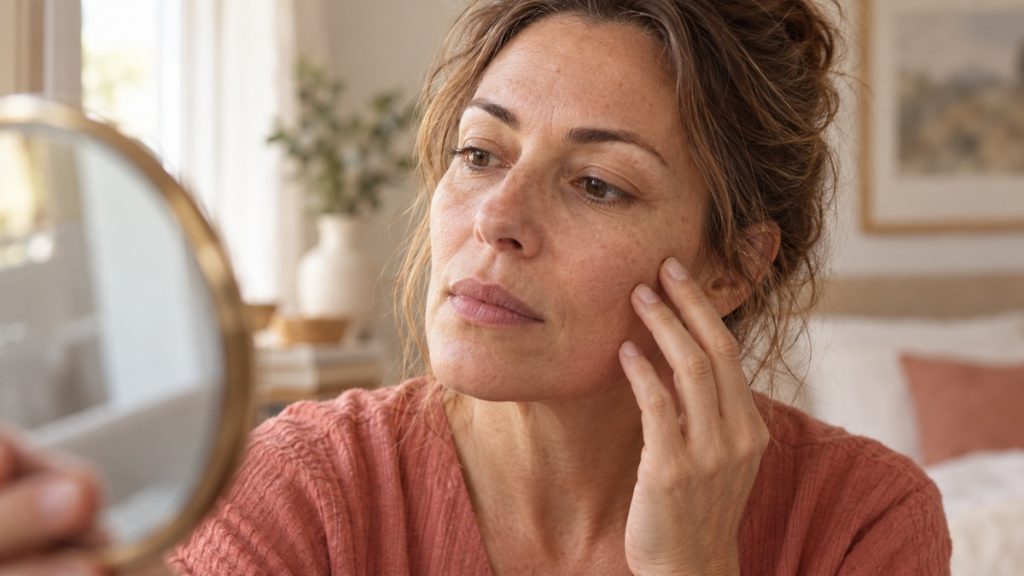
The first thing she said as she sat down was: “I haven’t put on weight and I’m not ill. But I look in the mirror now and the whole thing has just dropped.”
Then she added: “And I’m tired all the time. I had a cold last month and it took three weeks to clear.”
That same afternoon another patient came in, the same age as her, in markedly different shape. Clinical observation
One age, two outcomes. What people have started calling cliff-edge ageing is this gap. What I want to talk about is where the fork between them actually sits.
Who this is for: people between 35 and 55 who feel something changed recently and feel it changed suddenly — whether you already have a routine or have not started at all.
Established knowledge — what the field already knows: anatomy, physiology, mechanism, established risk. The next study does not rewrite it.
Published evidence — research done on this specific question, with its size and limits stated. The finding may be positive or null, and later work may revise it.
Verifiable fact — a matter of record, checkable by anyone.
Clinical observation — what I have seen in my own clinic, with the scope of it stated. It carries less weight than the literature, and I would like you to read it at that weight.
- Two accounts, as a way in
- The two accounts side by side
- “Should I be seeing someone else?” — there are two layers to that
- Cliff-edge ageing after 35 is real
- The four expectations people arrive with
- What I actually care about is whether it stays in
- Why some people age slowly
- Not only the face: tired, catching things, and taking a long time
- Why it shows more after menopause
- Effort yes, anxiety no
- If you feel it is already too late
- What I can and cannot do
Two accounts, as a way in
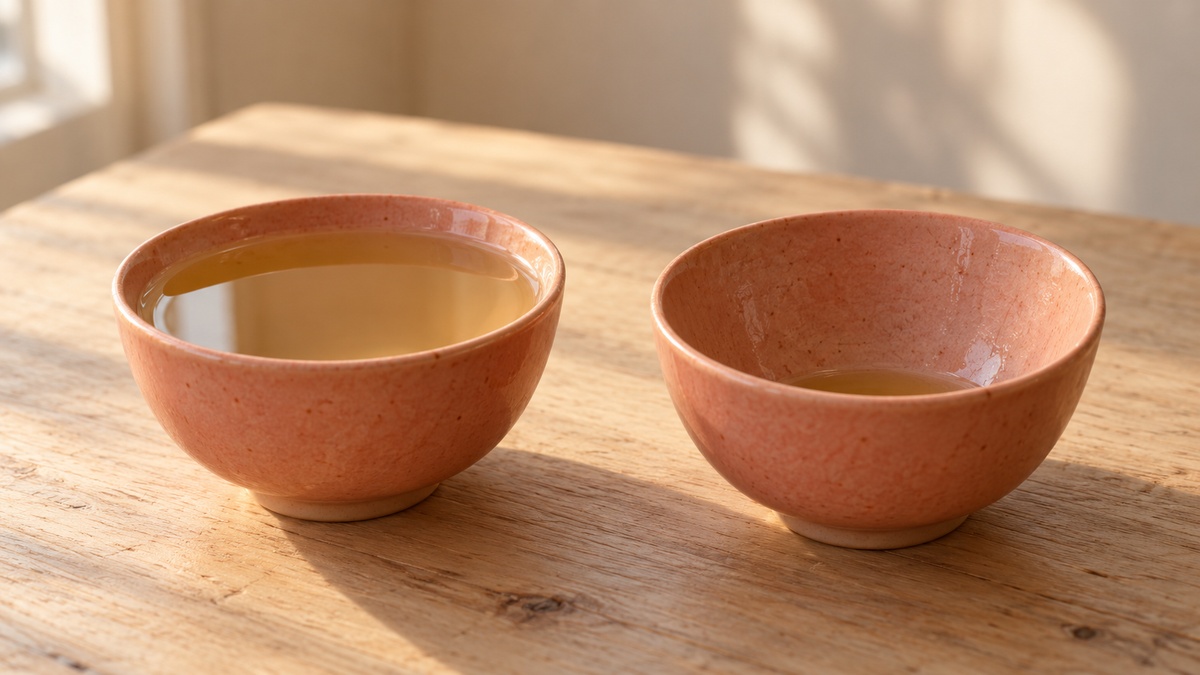
I talk about the body in terms of money a great deal in clinic, because people’s instincts about money are sharper than their instincts about physiology.
Your body runs two accounts.
One is the money on you. What you eat today, digest and absorb, and turn into energy you can spend today. In Chinese medicine this is the work of the spleen-and-stomach system — the term covers digestion and assimilation rather than the anatomical organs. Its character is that it moves fast in both directions: a bad night’s sleep or a few disorderly meals, and you feel it today.
One is the money in the bank. The reserve you have built across a lifetime, the one that covers the big events. In Chinese medicine this is the work of the kidney system — again a functional term, covering the body’s deep constitutional reserve rather than the organ a nephrologist treats. Its character is slow: slow to build, slow to fall, and hard to replace once you have drawn on it.
The money on you decides how today goes. The money in the bank decides whether you can take a hit.
Ageing, as I see it in clinic, is the balance between these two accounts. Spend without saving for long enough and you run a deficit. Where that deficit shows first is further down. Clinical observation
The two accounts side by side
| Money on you (spleen-and-stomach) | Money in the bank (kidney) | |
|---|---|---|
| What it does daily | Turns what you eat into usable energy and materials for today | Sits there, covering illness, injury and stress |
| When it runs short | Tired today, poor digestion, colour drops, the face goes first | You cannot take a challenge, illness drags, recovery slows |
| Can it be replaced? | Yes, and faster than you would think | Slowly. Only by putting a little back, daily |
| How the classics describe it | An army’s supply line | The root of a tree |
| How to check the balance | The Chongyang (ST42) pulse, on the top of the foot | The Taixi (KI3) pulse, between the inner ankle and the Achilles tendon |
The last two rows are not my metaphors. A physician in the Ming dynasty wrote them down. That comes later on this page.
“Should I be seeing someone else?” — there are two layers to that
Before any conversation about ageing, I separate these two. Get the order wrong and everything after it is wasted.
Layer one: is there actually a disease? Thyroid disease, anaemia, liver and kidney function, blood glucose, autoimmune disease, sleep apnoea. Each of these can make a person look as though they are ageing fast, and each has its own route — through your primary care physician, or the relevant specialist where you live.
Layer two: expectation. No disease, but the state keeps sliding, and you would like it to slide more slowly.
Layer one has to be excluded first. If your recent change has been fast and does not add up — losing a lot of weight within six months, persistent fever, unexplained bruising, periods stopping abruptly, exhaustion severe enough to interfere with your life — go and get examined. Do not stay here working at it.
I want to be very clear. “Looking old” is not a diagnosis. It can be the result of how you have been living, and it can be something not yet found speaking up. I cannot tell those two apart from a face, so I will ask, and I will send you to check.
Layer two is what this page is about. Health can be actively supported, and there are methods for doing it.
Cliff-edge ageing after 35 is real
People often tell me: “It didn’t feel gradual. I just suddenly noticed it was different.”
I used to treat that as a subjective impression. Research over the last few years changed my mind.
Two studies, different methods, the same finding
Ageing does not run at a constant rate. It comes in waves, with turning points.
A study measured 2,925 plasma proteins in 4,263 adults aged 18 to 95, and found the plasma proteome changes with age in a clearly non-linear way. Waves of change appeared in the fourth, seventh and eighth decades of life, each reflecting distinct biological pathways. Published evidence
The first of those waves lands in the thirties. So “everything changed after 35” has something real behind it — at the level of a population. It is not evidence that an individual cliff arrives at 35.
This study should be read conservatively:
- It describes when molecules in blood change. It does not demonstrate at what age you will get older.
- “The fourth decade” is a span, not a birthday.
What it supports is one sentence: ageing does not run at a constant rate. That sentence holds.
There is a well-known study whose numbers I decided not to use
Writing this, I had intended to cite a 2024 paper in Nature Aging: a longitudinal multi-omics analysis of 108 people, concluding that dysregulation clusters around two periods, roughly 44 and 60. Those two numbers travel widely online, and most of the “44 is the first threshold” talk comes from them.
While checking it, I found an Editor’s Note on the journal’s article page, dated 15 July 2026:
Readers are alerted that, following further review by the authors and independent researchers, the reliability of some of the analyses used in this article to detect peaks of changes in molecular aging markers around certain ages is currently in question. The authors are working with the editors to assess the scope of the issue and appropriate corrections. Appropriate editorial action will be taken in due course. The authors agree to the posting of this notice.
What is in question is precisely the part that detects peaks at particular ages — which is to say, those two numbers.
📌 The note does not appear in PubMed. You have to open the journal’s own article page to see it. I am writing this down because you have very likely met “44” somewhere else. The paper has not been retracted, and those two numbers should not be treated as settled.
So I do not use them here. I keep one sentence — ageing does not run at a constant rate — because a separate dataset of more than four thousand people holds it up.
Why it feels sudden
Because what you see is the result. Nobody watches the process.
The money on you goes out continuously and you do not notice it daily. Then one morning you look in the mirror, or a minor cold takes three weeks, and the statement arrives.
The classical texts describe it the same way. The Lingshu chapter “The Natural Span of Life” sets out ageing in ten-year stages, and marks each stage in an interesting way — by what a person at that age feels like doing. At 20, likes to hurry. At 30, likes to walk. At 40, likes to sit. At 60, likes to lie down.
For the fortieth year the text reads: the texture of the skin begins to loosen, the bloom begins to fall away.
⇒ So the cliff has been noticed from both directions. The language differs.
The four expectations people arrive with
I list these without any intention of mocking anyone. I list them because which one you hold decides how well this goes.
| The expectation | What is actually the case |
|---|---|
| “Is there something that fixes it in one go?” | No. Twelve hallmarks of ageing have been set out, and they run at the same time. One move does not address twelve things |
| “I take plenty of supplements — why do I feel nothing?” | Materials get in. Something still has to pick them up and use them. While the body is on alert, repair gets pushed down the queue |
| “I want to look 25 again” | Not possible. What I can do is help you reach the upper edge of the age you actually are |
| “I’ll start once this busy stretch is over” | The stretch between 35 and 55 is when withdrawals run fastest. It is the worst one to wait through |
What I actually care about is whether it stays in
This is the central judgement I make about ageing, and it decides how my whole clinic runs.
What I care about is not how old you look now. It is how much you can still keep in.
Because looking young can be achieved by a number of routes, and some of them are paid for with further withdrawals. Buying today’s appearance with tomorrow’s savings is a trade I do not think works out. Clinical observation
Li Zhongzi wrote this down as two lifelines
Many people assume the saying “the kidney is the root of what came before birth, the spleen the root of what comes after” is from the Huangdi Neijing.
It is younger than that. It comes from Li Zhongzi’s Yizong Bidu (Required Readings for Medical Practitioners), volume one, completed in 1637. It is not found in the Neijing or the Nanjing, and opinion inside Chinese medicine remains divided about it to this day. Verifiable fact
I still cite him, because the two images he wrote down are ones I have used in clinic for years.
The spleen and stomach: an army’s supply line.
He wrote that the spleen and stomach are like the supply route of an army; let the supply route be cut, and ten thousand men scatter at once. Cut the supply and the force collapses on the spot — no gradual weakening, just collapse. He goes on: once stomach qi fails, a hundred medicines cannot be applied. When a person cannot eat or cannot absorb, no prescription moves anything.
The kidney: the root of a tree.
He wrote that a person having a foot-position pulse is like a tree having a root; though the branches and leaves wither, the root will grow again. Branches can die back. If the root is there, it comes again. If the savings are there, there is a way back.
Two accounts, two completely different ways of failing, written into one passage.
And he wrote down how to check each balance
Always take the Taixi, to examine whether kidney qi is flourishing or failing; always take the Chongyang, to examine whether stomach qi is present.
Taixi (KI3) sits on the kidney channel, in the hollow between the inner ankle bone and the Achilles tendon. Chongyang (ST42) sits on the stomach channel, on the top of the foot where the dorsalis pedis pulse can be felt. Two pulse points, two passbooks. I still use the habit. Clinical observation
Which is why I do not open with the kidney
For people who come to me between 35 and 45, I rarely start in the direction of the kidney.
Because when the Suwen chapter “On the Heavenly Truth of High Antiquity” describes the stages of a woman’s life, the three characters it places before “the face begins to wither” are the yangming channel declines — and yangming is the stomach channel. The passage that genuinely concerns the kidney comes fourteen years later in the same text.
In clinic my order is usually: get the money on you clear first, then talk about the bank. For someone who is sleeping badly, eating badly and digesting badly, the expensive things will not stay in.
📌 This is also why I prescribe individually and adjust at follow-up. Everyone’s near account looks different, and it keeps moving.
Why some people age slowly
Back to the two people the same age.
Something I have to admit first
What I see in clinic is a skewed sample.
The ones in good shape mostly do not come. They are fine; they have no reason to see a doctor. So the impressions I have accumulated come from people who already felt something was wrong before they walked in. Clinical observation
I write that down because it changes how you should read the table below. This is not population data. It is the distribution one Chinese medicine physician sees in one clinic.
One is saving. Two are digging
Among the people who come to me, the ones ageing faster usually fall into two kinds, and the two dig differently.
| Saving (rarely comes to see me) | Digging, type 1 — not moving, and eating in the manner of a diet | Digging, type 2 — stressed, wound tight, sleeping badly | |
|---|---|---|---|
| Money on you | Something comes in daily | Income chronically short | Income arrives, but will not move |
| Money in the bank | Both muscle and bone are accumulating | Drawing on the capital as well | Permanently on emergencies; nothing is set aside |
| How it feels inside | Flowing | Empty | Blocked |
| After 35 | Declines, but slowly | Declines fast and visibly | Repair is especially poor; everything takes a long time to resolve |
Clinical observation
Flowing, empty, blocked. The last two are both digging, but one has no income and the other cannot move the income it has.
Why type 2 counts as digging. This one is most often misread, because these people often eat well and do look after themselves. The problem sits elsewhere: inside, it is like traffic. Things arrive and do not reach where they are needed.
A person who is wound tight for long enough is driving with a foot on the accelerator permanently. Repair happens on the other side of that, and they almost never cross over. So there is money in the account, and the money is stuck on the road.
What I see clinically is consistent: shallow sleep, waking still tired, a neck and shoulders that never let go, digestion that comes and goes, and a stomach or bowel that reacts first to anything stressful. Then colds are caught easily and take a long time to clear. Clinical observation
📌 The two kinds need opposite orders. Type 1 needs income restored first — eat enough, start moving. Type 2 gets more blocked if you start by adding, so the road has to be cleared and sleep recovered first. This is why I do not work from a fixed prescription.
Type 1: the cost has been measured.
A randomised trial of 101 postmenopausal women compared severe with moderate energy restriction. At 12 months the severe group had lost 6.6 kg more weight, and also 1.2 kg more whole-body lean mass, 4.2 cm² more thigh muscle cross-sectional area, and lost more total hip bone mineral density (effect size 0.017 g/cm²). Published evidence
Read this one honestly:
- The lean mass and thigh muscle losses were proportional to total weight lost, rather than an additional abnormal loss.
- There was no difference in grip strength between the groups.
So the accurate statement is: the harder you cut, the more capital goes with it, bone included. I will not say that dieting makes you weak. This study does not support that sentence.
And the ones who do move?
A systematic review and meta-analysis in postmenopausal women pooled 12 randomised trials, 452 people, and found that resistance training (within 16 weeks), compared with no exercise, appeared to improve functional capacity and bone density. Published evidence
📌 The authors are careful about it themselves: risk of bias in the included trials ran from unclear to high, overall certainty of evidence was low to very low, and better-quality trials are still needed. I cite it because the direction agrees, rather than because it settles anything.
“Ageing fast” is a rate, and rates can be measured
A research group built a DNA methylation measure that tracks the rate of decline across nineteen indicators of organ-system integrity, modelled within the same individuals across four time points over twenty years, to estimate a pace of ageing.
That pace is associated with later morbidity, disability and mortality. One finding stayed with me: people who experienced adversity in childhood showed a faster pace of ageing. Published evidence
Withdrawals, very often, started a long time ago.
⚠️ Commercial epigenetic-age tests are available, including ones built on DunedinPACE, but their usefulness for an individual diagnosis or treatment decision is not established, and there is no intervention evidence that improving the score improves health. I mention it to make one point: people of the same age really do age at different rates.
Not only the face: tired, catching things, and taking a long time
If you remember one sentence from this page, I would like it to be this one:
The face is the display. The machine is behind it.
What shows on the face is output. What needs changing is on the other side.
Facial ageing runs on the same machinery as the rest of you. Twelve hallmarks of ageing have been set out, covering genomic instability, telomere attrition, epigenetic alterations, loss of proteostasis, disabled macroautophagy, deregulated nutrient sensing, mitochondrial dysfunction, cellular senescence, stem cell exhaustion, altered intercellular communication, chronic inflammation and dysbiosis. The hallmarks set out for skin ageing — three categories, seven hallmarks — are very nearly a subset of the same list. Established knowledge
So a face is not a separate cosmetic problem. It is the same machinery, leaving its record in the most visible place.
The “catching things” half. The immune system undergoes a set of changes with age, collectively called immunosenescence, accompanied by a low-grade, sterile chronic inflammation. Both play a part in most chronic diseases of later life. Established knowledge
The “takes a long time” half. This is the one I most want to get right, because it is routinely misread. On wound healing in older people, the consensus of the review literature is that healing is delayed, but the final result is qualitatively similar to that in younger people. Established knowledge
The weight of that sentence sits on slow, not on broken.
That sentence is about wound healing, and I am not going to stretch it into a claim about how long a cold should take — recovery time after a viral illness is non-specific and has many causes. Clinical observation What I take from it is narrower and more useful: in the bodies I see, slow is the usual finding, not broken. And speed is something that can be rebuilt.
Why it shows more after menopause
Two things stack.
First, that point falls near the next wave. The seventh-decade wave in the plasma proteome sits in this stretch.
Second, skin collagen does fall. A 1987 study measured thigh skin collagen in postmenopausal women and found it declined significantly with years since menopause. Published evidence
But here I put the brakes on. The second half of that study is an observational comparison concerning hormone replacement, with small numbers (69 untreated, 37 on replacement) and from a long time ago.
Taking hormones for the sake of skin is not supported by current clinical guidance. I have written the same sentence in the perimenopause piece and my position is the same here. Decisions about hormone therapy belong with a gynaecologist or menopause specialist. In this practice I work as a Chinese medicine physician and do not prescribe pharmaceutical medication.
Effort yes, anxiety no
This is the section I most wanted to write.
There is a line in the Suwen chapter “The Great Treatise on the Correspondences of Yin and Yang” that I think is the best two-thousand-year-old answer to why some people age faster:
Know it and you are strong; fail to know it and you grow old. Both come from the same place and are given different names.
The same starting point, ending with two different names on it — one called strong, one called old. What separates them is knowing how.
And the line that follows matters more:
The old can be restored to vigour; the vigorous can be better governed still.
Those already old can recover ground; those still strong can do better. Two thousand years ago nobody wrote the ending as fixed.
So, effort. Anxiety does not help
There is a state I dread seeing in clinic: someone who has turned anti-ageing into a second job. Reading everything, buying a great deal, checking their face daily, lying awake worrying about it.
The problem is that anxiety is itself a withdrawal. While the body is on alert for long stretches, repair gets pushed down the queue. What you put in is not useless — the body has no capacity to pick it up. Clinical observation
My advice is always the same: do not start ten things. Pick one, make it a habit, then add the next.
📌 If you want an order from me: sleep, then food, then movement. Sleep is the largest deposit available daily. Food is the material. Movement is saving capital. Stress is the easiest one to overlook, and it withdraws continuously.
If you feel it is already too late
This section is for people who think they started too late.
I will say the honest part first. Some things do not come back. Bone that has gone, structure that has changed, the decade that has passed — I will not pretend I can return those to you.
I will also not say “too late”, because that is neither accurate nor useful.
The part you can influence is larger than you think. And starting today rather than next year makes a real difference.
Anyone willing to adjust their hours, willing to sit down to a proper meal, willing to go for a walk when they are tired — you are already saving. A deposit does not stop counting because it started late.
What I can and cannot do
| What I can do | What I cannot do |
|---|---|
| Work out first whether you need another specialty — whether disease is present, and whether the expectation needs Western medical intervention | Return you to 25 |
| Work out which account is the problem right now, and deal with the near one first | Turn bone and structure that have already gone back into what they were |
| Prescribe according to individual pattern differentiation, working on sleep, digestion and stress — the foundations | Replace your own sleep, eating and activity |
| Use facial acupuncture at the structural layer of the face, as stimulus and as a reminder | Prescribe pharmaceutical medication or hormones |
Last
Back to the two people the same age.
The gap cannot be explained by genes alone, or by what either of them bought. Across the last ten years one of them was saving and the other was drawing down.
The good news is that an account can start accumulating at any time.
Ageing well takes effort. It does not require you to be anxious about it.
Pick one thing first.
Common questions
I started feeling tired in my thirties — is that kidney deficiency? Not necessarily. At that age most of what I see is the near account: sleep, meals, stress. I look at those first. And tiredness can also be a signal of disease, so what should be checked still needs checking.
Should I get my biological age tested? The pace-of-ageing measure described above is a research tool. It is not available as a clinical test, and there is no intervention evidence that improving the score improves health. The things you can feel yourself — how you sleep, your stamina, how fast you recover — are more informative.
Can I lose weight and work on ageing at the same time? Yes, with care about method. What the research shows is that the harder you cut, the more lean mass and bone density go with it. If the goal is long-term, I would go slower, pair it with resistance training, and not economise on protein.
Should I be taking supplements? I have nothing against them, but their place is material. However much material there is, it will not stay in if the body has no capacity to use it. And for people taking a lot of different ones, I ask to see the list, to avoid duplication and interactions.
I am in my fifties — is there any point starting now? Yes. The part you can influence is larger than you think. And the fifties sit just before the next wave. What you put in now is what gets drawn on later.
How long before Chinese herbal medicine shows anything? I cannot give you a number of months through a screen; that depends on the state you arrive in. But I can tell you what I assess: not the face. Sleep, stamina, digestion and speed of recovery. Those move first, and the face follows.
- Ageing care is not a facelift — it is bringing the body back to a house you can live in for a long time (in Chinese)
- Is it perimenopause? Work out which stage you are in first (in Chinese)
- Rebuilding recovery capacity: a map from the face to daily life (in Chinese)
- Sleep is the largest deposit the recovery bank takes (in Chinese)
- The raw material for recovery: are you eating enough protein? (in Chinese)
- Is declining stamina an inevitable part of ageing? Measure these four numbers first (in Chinese)
- Why your face ages: the layers, from skin to bone (in Chinese)
- What each anti-ageing treatment actually reaches
This is health education. It is not a guarantee of any outcome and cannot replace an in-person assessment. In this practice I work as a Chinese medicine physician and do not prescribe pharmaceutical medication; anything here concerning hormone therapy should be decided with a gynaecologist. Sections marked Clinical observation are impressions accumulated in my clinic and carry less weight than those marked Established knowledge — please read them at that weight. Herbal prescriptions referred to here require in-person pattern differentiation and should not be taken on your own initiative. Last medical review: 6 September 2026.
Classical sources. Huangdi Neijing: Suwen, “On the Heavenly Truth of High Antiquity”; Suwen, “The Great Treatise on the Correspondences of Yin and Yang”; Lingshu, “The Natural Span of Life”. Li Zhongzi, Yizong Bidu, volume one, 1637.
⚠️ The saying “the kidney is the root of what came before birth” is not found in the Huangdi Neijing or the Nanjing. It was first proposed by Li Zhongzi in the Ming dynasty, and opinion within Chinese medicine remains divided. Classical passages are quoted to show how the tradition described things, and are not offered as evidence of efficacy.