Facial resting posture is how the face looks when it stops. Facial expression recovery is how it moves. Whether an expression line turns into a line you can see at rest depends on whether muscle and skin come back after each expression.
“Doctor, I get so many lines at the corners of my eyes when I smile. Should I smile less?”
I am asked this a lot.
My answer is always the same. Smiling is fine. What matters is whether the lines fade once the smile is over.
I call this facial expression recovery.
Facial Expression Recovery(臉韻)
The ability, when making an expression, to move the muscles that should move while the unrelated ones stay still, and afterwards to bring both muscle and skin back to where they were. Facial resting posture is how the face looks when it stops; facial expression recovery is how it moves.
In facial palsy care, “recovery” usually means movement returning after a nerve injury. Here the word means something everyday: a face with healthy nerves coming back after each expression.
Established knowledge — what the field already knows: anatomy, physiology, mechanism, established risk. The next study does not rewrite it.
Published evidence — research done on this specific question, with its size and limits stated. The finding may be positive or null, and later work may revise it.
Clinical consensus — practice that physicians in this field broadly agree on.
Clinical observation — what I have seen in my own clinic, with the scope of it stated.
Working hypothesis — my own reasoning, which I cannot yet support. I expect to be wrong about some of it.
- One still, one moving
- Coming back has two halves
- How an expression line stays
- Moving beautifully matters less
- What good expression recovery looks like
- How I look after it
- One thing you can do today
- Common questions
One still, one moving
In the article on facial resting posture, I described how the face looks when it makes no expression: the length each muscle stops at, and the tension it holds.
Facial expression recovery is the other side: the face in motion.
| Facial resting posture | Facial expression recovery | |
|---|---|---|
| When to look | Face relaxed, no expression | Smiling, talking, frowning |
| What you look at | The length the muscles stop at | Whether the right muscles move, and whether everything comes back |
| When it is good | No strain and no droop at rest | Expressions move freely, and lines fade afterwards |
| With age | Muscles rest too short or too slack | Lines linger after moving, and slowly show even at rest |
The two are connected. Each small amount that fails to come back after moving adds up, and becomes how the face looks at rest.
Coming back has two halves
After an expression, two things need to return.
The muscle half: back to its usual length
After a smile, the muscles that lifted the corners of the mouth should let go and return to the length they rest at.
Some stay faintly drawn in after the smile, stopping a little short. Over time, that shorter length becomes where they rest. These are the muscles I described in facial resting posture, still working while the face is still. Clinical observation
The skin half: springing back
Each smile folds the skin at the corner of the eye once. When the smile ends, the skin has to spring open again.
One study measured 300 people aged 20 to 74. Every measure of skin elasticity declined with age, and the one that declined most was the ability to spring back after being stretched. Published evidence
What the research says: each person was measured once and age groups were compared. The same people were not followed over time.
So the older we get, the more slowly the lines from the same smile fade.
| The muscle half | The skin half | |
|---|---|---|
| Returns to | Its usual resting length | The smoothness it had before the fold |
| When it fails to return | Still faintly drawn in after the smile | Lines take a long time to fade |
| Where care goes | Relax muscles that rest too short; train control | Get the dermis stretched so new collagen forms |
How an expression line stays
Expression lines appear only while the face moves. Stop the expression and they are gone.
Some of the lines you can see at rest are expression lines that stayed.
A team in the United States built a computer model of the six layers of forehead skin and compared two things: lines pushed up by contracting muscle, and lines from tissue thinning with age. Where the two overlapped, the lines were deepest. Published evidence
What the research says: this is a computer simulation, not a follow-up of real people.
There is also a record of one pair of identical twin sisters. For 13 years, one had botulinum toxin regularly in the forehead and between the brows, and the other had almost none. After 13 years, the sister treated regularly had clearly fewer lines at rest in those two places. Where neither was treated, such as the nasolabial folds, the two had aged much alike. Published evidence
What the research says: this is a single pair of twins, a case report, and it cannot be applied to everyone. What it can show is a direction: when one area is folded far less for many years, lines there are less likely to stay.
I read these two together. For a line to stay, two things have to happen. It keeps being folded, and after folding, the skin does not spring back. Working hypothesis
Moving beautifully matters less
Many people want to look good when they smile.
One study asked people to rate the attractiveness of the same individuals from photographs and from video. The two sets of scores were very close. Adding expression and speech did not change who looked more attractive. Published evidence
What the research says: the study looked at men’s faces.
Another study found that when watching a smile in motion, people relied less on the lines at the corners of the eyes to judge whether it was genuine. In still images they paid those lines more attention. Published evidence
What the research says: this study used computer-generated faces.
So this is the order I care about:
- While the face moves, lines count against it less. There is no need to stop smiling for fear of lines.
- What actually stays is whether the face comes back after moving.
- How beautifully it moves comes last.
What good expression recovery looks like
Good expression recovery has nothing to do with a blank face.
Able to smile: expressions are not stiff
The corners of the mouth lift when they should, and a smile comes easily.
Able to separate: unrelated muscles stay still
When smiling, the eyes and the corners of the mouth each move on their own, and the brows and chin do not join in. That is the control I describe in facial motor control.
Able to return: back where it started
After the smile, the muscles let go, the lines fade, and the face returns to how it rests.
With all three in place, expressions stay flexible and leave no extra lines behind.
How I look after it
For the muscle half, I first look at which muscles are still drawn in after a smile and help them relax, then wake the ones that should move. Facial acupuncture adjusts the elasticity and tension of these muscles. Clinical observation
In training, what I care about is the muscle doing the work while the skin over it stays unfolded. Keep the effort in the muscle, and the skin is folded one time fewer. I explain the principles in my article on facial exercise (in Chinese).
For the skin half, the dermis has to be stretched for new collagen to grow. That is the fabric in the tent model.
What the research says: the idea that a muscle working with the skin held still folds fewer lines is my own reasoning. No study has measured it directly. Working hypothesis
One thing you can do today
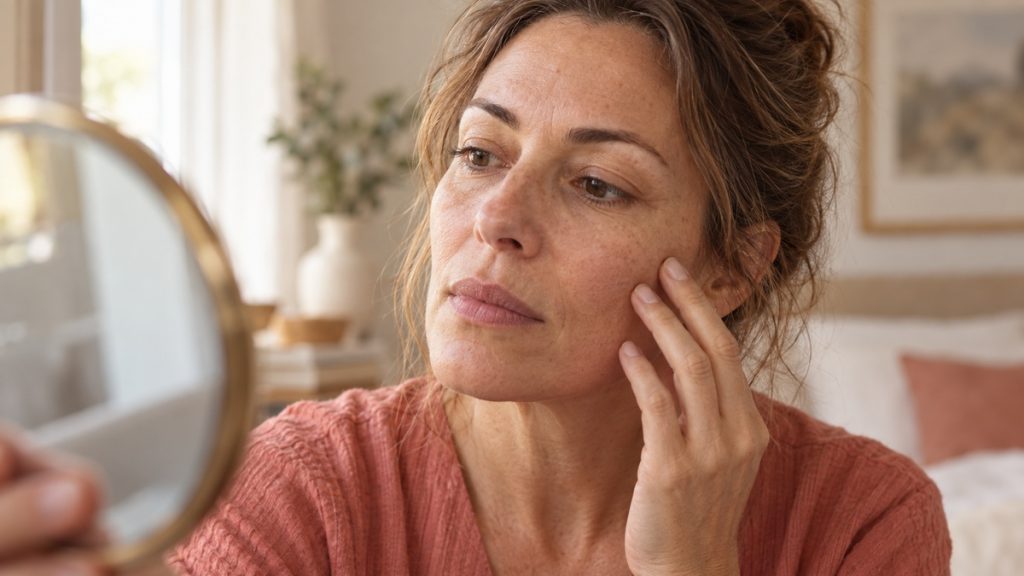
In front of a mirror with even light, smile naturally, hold it for three seconds, then relax completely.
Count how many seconds the lines at the corners of your eyes and around your mouth take to fade.
Look again. Once relaxed, are the corners of your mouth back at the height they were before the smile?
- Lines fade slowly: the skin half is declining.
- The corners of the mouth do not return: the muscle half has settled short.
For now, it is enough to know which half it is.
Where the term comes from
I first published facial expression recovery(臉韻) in Chinese on 3 November 2026, in the original of this article (in Chinese). I named it as the moving counterpart to facial resting posture(臉態). In Chinese, 韻 is the word for the rhythm and grace of something in motion.
Definitions and first-publication dates for every term in this series are in the glossary (in Chinese).
Common questions
What is facial expression recovery?
It is a concept used by Yi-Ching Lee, MD: the ability, when making an expression, to move the muscles that should move while the unrelated ones stay still, and afterwards to bring both muscle and skin back to where they were. Facial resting posture is how the face looks when it stops; facial expression recovery is how it moves.
Should I smile less to avoid expression lines?
There is no need to. Lines that appear while the face moves count against it less. What stays is whether the lines fade once the smile is over, so the thing to look after is coming back.
How are expression lines different from lines at rest?
Expression lines appear only while you make an expression and disappear when you relax. Some lines visible at rest are expression lines that kept being folded while the skin no longer sprang back. Others come from tissue thinning with age.
What does it mean if lines take a long time to fade after a smile?
It may mean the skin’s ability to spring back after being stretched is declining, which is the part of skin elasticity that ages fastest. It may also mean nearby muscles are still faintly drawn in after the smile. In front of a mirror, check whether the lines fade slowly or the corners of the mouth fail to return.
Can expression recovery be trained?
The control part can: moving the muscles that should move while the unrelated ones stay still. In training, the point is for the muscle to work while the skin over it does not fold. Whether training makes expression lines shallower has not yet been studied directly.