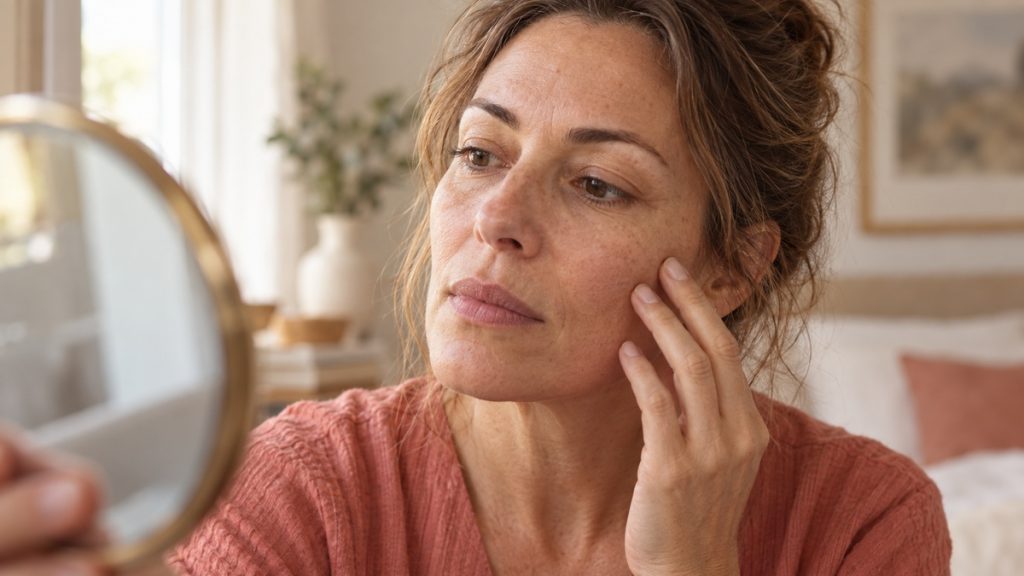
The core of the body is stability: standing on one leg without wobbling. The core of the face is control: when you make an expression, the muscles that should move do, and the unrelated ones stay out of it. A lot of facial asymmetry, and smiles that pull to one side, has to do with this.
One of the simplest things I do when I look at a face is ask the person to smile.
Many people look fairly even when relaxed.
Then they smile or speak, and one corner of the mouth sits higher than the other, one eye narrows more than the other.
This kind of asymmetry hides in movement. It has to do with an ability that is often overlooked, which I call facial motor control.
Facial Motor Control(臉的控制力)
The ability, when making an expression, to move the muscles that should move while the unrelated ones stay still, and to return to rest afterwards. It is to the face what core stability is to the body.
Motor control is a long-established term in neuroscience and rehabilitation. I use it here in a narrow, everyday sense: how cleanly a healthy face makes one movement at a time.
Established knowledge — what the field already knows: anatomy, physiology, mechanism, established risk. The next study does not rewrite it.
Published evidence — research done on this specific question, with its size and limits stated. The finding may be positive or null, and later work may revise it.
Clinical consensus — practice that physicians in this field broadly agree on.
Clinical observation — what I have seen in my own clinic, with the scope of it stated.
Working hypothesis — my own reasoning, which I cannot yet support. I expect to be wrong about some of it.
- The body’s core is stability; the face’s is control
- How I check control in clinic
- Muscles working overtime
- Facial asymmetry: I used to think it was inborn
- Control lost at the extreme: synkinesis
- Training control
- One thing you can do today
- Common questions
The body’s core is stability; the face’s is control
Mention the core and most people think of the abdominal muscles.
The simplest test of the core, though, is standing on one leg. People who are steady use the muscles that need to work, and everything else stays quiet. People who are not steady wave their arms, hunch their shoulders and grip with their toes. The whole body joins in to help.
The face is the same.
| Body | Face | |
|---|---|---|
| What the core is | Stability | Control |
| How to test it | Stand on one leg and see whether you wobble | Move one side only and see whether the other side and the eyes join in |
| When it is poor | The whole body tenses to stay steady | One expression, and the whole face strains |
| Over time | The places that compensate grow sore and tight | The muscles working overtime settle short and become part of facial resting posture |
How I check control in clinic
These are three movements I use myself.
Smile: does movement differ left and right?
I ask the person to smile naturally.
The face at rest may look fine. When smiling or talking, some people have one corner of the mouth higher than the other, or one eye narrowing more. Clinical observation
Puff one cheek: does the other side join in?
I ask the person to puff out only the right cheek.
With good control, the right cheek fills and the left side and the area around the eyes stay still. With poor control, the left side tightens as well, and the eyes narrow. Clinical observation
Lift one corner of the mouth: does the whole face strain?
I ask them to lift only the right corner of the mouth, then the left.
Many people find one side much harder. To get it up, the brows, nose and chin all join in. Clinical observation
Muscles working overtime
One movement may need only one or two muscles.
When control is poor, the brain cannot call on that one precisely, so it calls several nearby muscles in to help. Those muscles are working overtime.
Where the overtime happens differs from person to person. The place I see go wrong most often is around the corners of the mouth. Clinical observation
That makes sense. Everyone talks and eats every day, and the area around the mouth is the most used part of the face.
After working overtime for long enough, those muscles settle short and do not come back. They are the muscles I described in facial resting posture, still working at rest, and the ones I first want to relax with facial acupuncture. Clinical observation
Facial asymmetry: I used to think it was inborn
When I first noticed this asymmetry in movement, I assumed it was inborn, or else the result of a nerve injury.
After seeing many more faces, I now think it is often closer to a habit of how the muscles are used. Clinical observation
Sport makes this easy to picture.
One study compared boys around ten years old who played tennis. In the group training five days a week, the playing arm had about 13% more lean mass than the other arm and about 22% more bone mineral content. In professional players the gaps were larger. The more training, the bigger the difference between the two sides. Published evidence
What the research says: this is the arm, in tennis. There is no equivalent study of the expression muscles, and applying it to the face is my own reasoning. Working hypothesis
Badminton and tennis players use the same hand every time, and their two arms grow differently. The face is similar. Whichever side you habitually chew on, smile with, or speak with more force, the muscles there are shaped differently by use.
Faces also change after a switch of language or after orthodontic treatment. I give those examples in my article on facial accent (in Chinese).
Sleeping on the same side
I also often see that people who always sleep on one side have a flatter face on that side, and the muscles there feel stiffer and less elastic. Clinical observation
Bone may play a part as well. Living bone is constantly removed and rebuilt, a little like silt in a river, carried off in one place and laid down in another. The direction of long-term load changes its shape.
What the research says: a Finnish birth cohort followed 70 children to age six and found sleeping position was one possible factor in facial asymmetry at six. I have not found studies of side sleeping and the adult face; that paragraph is my clinical observation.
Control lost at the extreme: synkinesis
In people whose facial palsy has not fully recovered, one after-effect is called synkinesis.
The typical picture: on opening the mouth or moving its corner, the eye on the same side closes, beyond the person’s control. This is oral-ocular synkinesis. The reverse, where closing the eye pulls the corner of the mouth up, is ocular-oral synkinesis. Established knowledge
The cause lies in the nerve. As the injured nerve regrows, some fibres connect to the wrong targets, so a signal meant only for the eye also reaches the mouth. Established knowledge
| Everyday poor control | Synkinesis | |
|---|---|---|
| Where it comes from | Long-term habits of use | Miswiring as the facial nerve regrows after injury |
| What it looks like | Mild, and often unnoticed by the person | Obvious, and cannot be controlled at will |
| Direction of care | Relax the muscles working overtime, and retrain moving only the one | Assessment by a doctor; usually neuromuscular retraining, sometimes with botulinum toxin |
What the research says: synkinesis is managed mainly with neuromuscular retraining and botulinum toxin. Randomised trials of facial retraining are still few.
I put the two side by side because they sit on the same line. Synkinesis is control at its worst. Most faces have only drifted a little way along that line.
If your face droops suddenly, seek medical care at once. For example, you wake with one corner of the mouth drooping and one eye that will not close fully, or you also have weakness in an arm or leg or slurred speech. Facial palsy and stroke have to be ruled out first. That is a different matter from the habits of use in this article.
Training control
Control can be trained. Facial palsy rehabilitation already does this.
When I train a face, what I care about is moving only the one muscle while everything else stays quiet. The muscle does the work, and the skin does not fold with it. How much force comes second.
Whether training control makes the face look better has not yet been studied directly. I treat it as a question under observation. Working hypothesis
What I see in clinic is this. Relax the muscles working overtime first, wake the ones that have been neglected, then make moving only the one a habit. That is how the face holds its resting posture. Clinical observation
One thing you can do today
Face a mirror and relax your face.
Lift only the right corner of your mouth, hold for three seconds, and let go. Then do the left.
Look for two things:
- Which side is harder to lift.
- Whether the brows, nose or chin join in as you lift.
The harder side, or the side that pulls the whole face along, is where control is weaker. For now, it is enough to know which side it is.
Where the term comes from
I first published facial motor control(臉的控制力) in Chinese on 3 November 2026, in the original of this article (in Chinese). What I add is narrow: placing control as the face’s equivalent of core stability, and reading the muscles that work overtime as one source of facial resting posture.
Definitions and first-publication dates for every term in this series are in the glossary (in Chinese).
Common questions
What is facial motor control?
As Yi-Ching Lee, MD uses the term, it is the ability, when making an expression, to move the muscles that should move while the unrelated ones stay still, and to return to rest afterwards. It is like core stability in the body: standing on one leg, the muscles that need to work do, and nothing else flails.
Is a smile that sits higher on one side, or one side of the face looking larger, something I was born with?
Part of it is the bone structure you were born with, and part may come from use. Whichever side you habitually chew on, smile with, or sleep on, the muscles there get used into a different shape. Asymmetry that is hard to see at rest and shows clearly in a smile often has to do with control.
My eye closes when I open my mouth. What is that?
That is synkinesis; the form where opening the mouth or moving its corner closes the eye on the same side is called oral-ocular synkinesis. It is common after incomplete recovery from facial palsy, because the nerve reconnected to the wrong targets as it regrew. It needs assessment by a doctor and is usually managed with neuromuscular retraining, sometimes with botulinum toxin.
What should I do if my face suddenly droops on one side?
Seek medical care at once. A sudden drooping mouth corner or an eye that will not close fully needs facial palsy ruled out first. If there is also weakness in an arm or leg, or slurred speech, it may be a stroke: call emergency services immediately.
Can facial motor control be trained?
Yes. Facial palsy rehabilitation already trains it, although randomised trials are still few. The point is to move only the one muscle while everything else stays quiet. Whether training makes the face look better has not yet been studied directly.